
The New Normal
The council’s share of non-unanimous votes rose over 600% in 2025. Will it last in 2026?

Happy New Year, Rose City Reform readers!
This morning, we’re excited to bring you our latest research report, an analysis of Portland City Council’s roll call votes in 20251.
Publishing this report today feels especially timely. In about an hour, the council is scheduled to reconvene to elect its president after nine tied rounds last week. The vote is emblematic of some of the friction that surfaced in 2025, when governance-related decisions made up a significant share of non-unanimous outcomes.
At the same time, it seems appropriate to point out that deadlocks were fairly rare overall. In 2025, they accounted for roughly 4% of all votes, and about 10% of all non-unanimous ones.
But now, and without further ado, here is a recap of our findings. For more data, visualizations, and a full methodology, read the full report.
Key Findings
The share of non-unanimous votes rose sharply in 2025
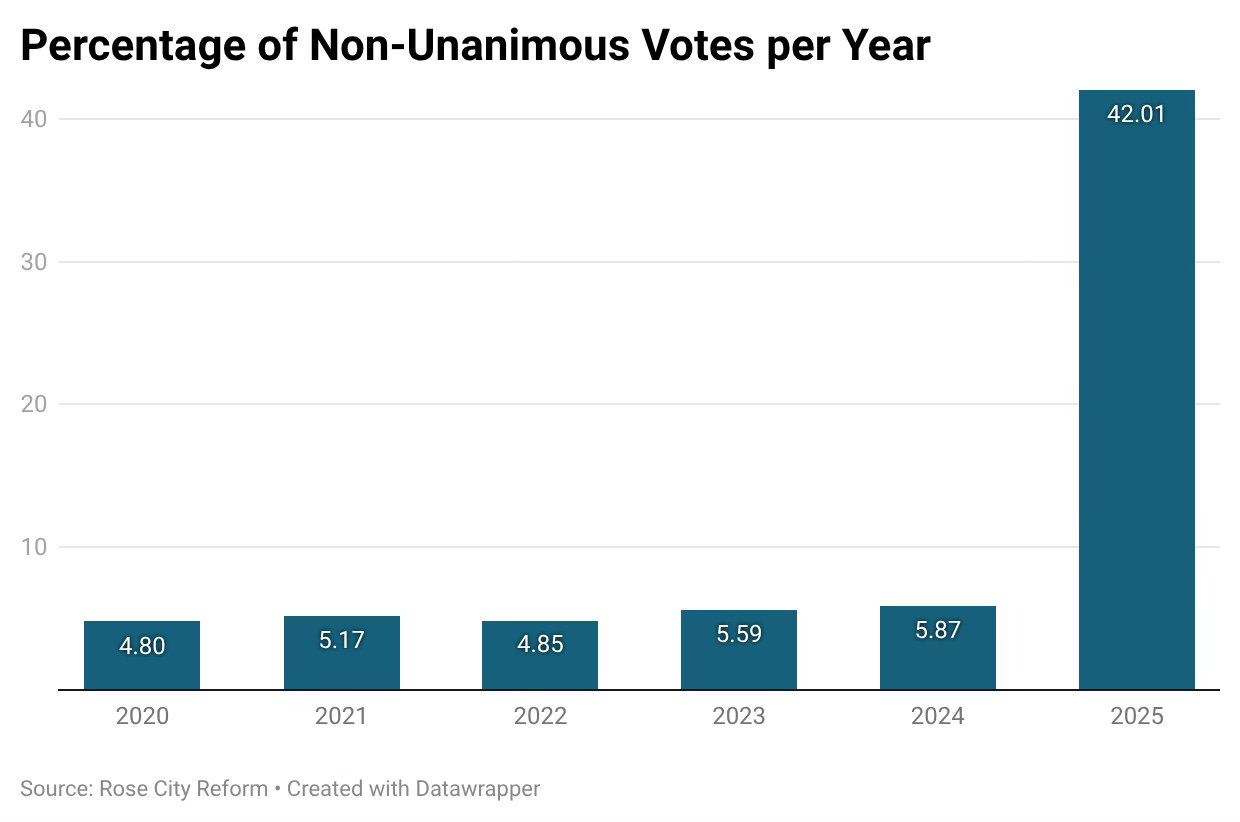
In 2025, roughly 42.1% of all votes were non-unanimous—a 617% increase over 2024. Compared with the five-year period from 2020 to 2024, when non-unanimous votes averaged roughly 5.3%, the increase was nearly 700%.
Councilors disagreed most over budget and governance
During a year marked by austerity, budget-related decisions accounted for nearly half (46%) of all non-unanimous votes. Much of the remaining disagreement involved governance (17%) and procedure (14%).
Ties and narrow votes made up 28%
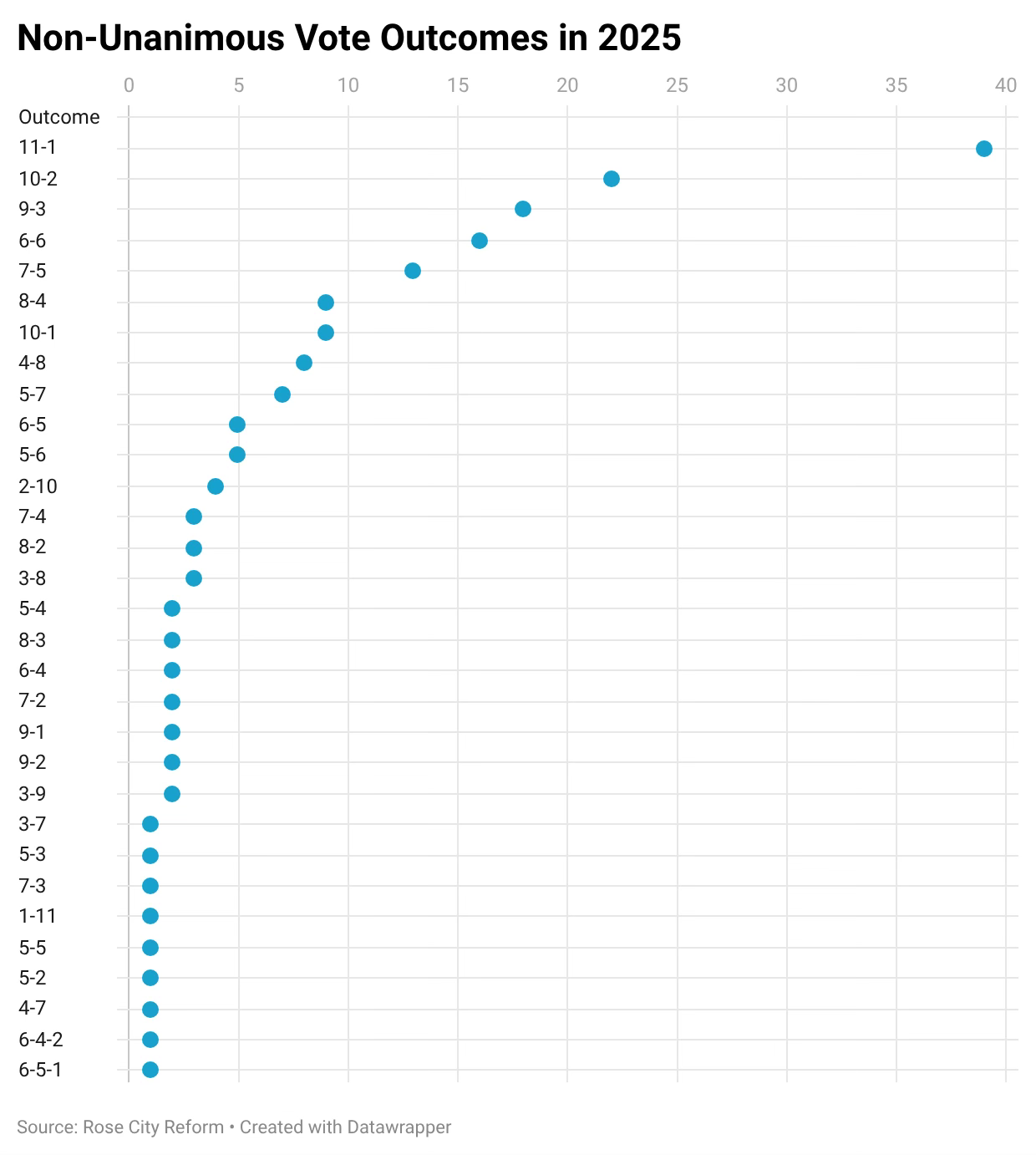
Most non-unanimous votes were not closely contested. Over half (53%) resulted in a supermajority, defined as at least nine councilors voting the same way. Nevertheless, votes decided by a margin of two or fewer—including ties—accounted for a substantial share: 28% of all non-unanimous votes.
Lone dissenters had company
The most common non-unanimous outcome was a single councilor disagreeing with the rest of the body. Most members cast a lone dissenting vote at least once during 2025. Dan Ryan did so most frequently, followed by Sameer Kanal and Eric Zimmerman.
Peacock members aligned the most
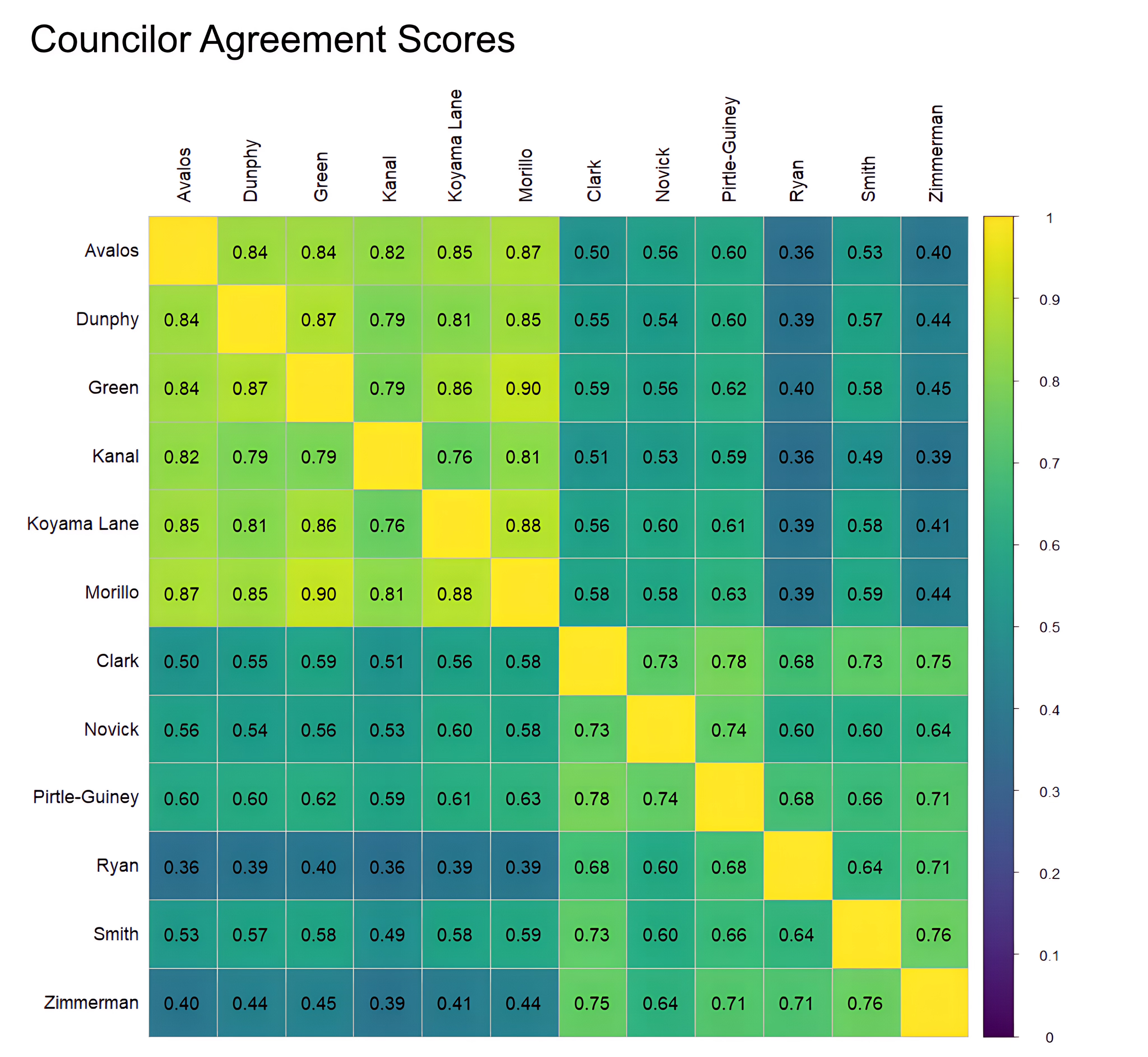
The council’s six-member progressive caucus (nicknamed “Peacock”) showed the highest levels of agreement. When two Peacock members were both present and voting, they agreed on average 84% of the time. Non-caucus members, who do not organize under a joint policy platform, showed lower average agreement (70%). Yet the data revealed two distinct groups: no caucus member agreed more frequently with a non-caucus member than with a member of their own group—and vice versa.
Caucus affiliation outweighed district affiliation
Caucus membership—or the absence of it—consistently proved a stronger predictor of voting behavior than shared district affiliation. Councilors representing the same district did not vote together at higher rates, including on votes with district-specific implications.
Most of the time, councilors worked it out
Disagreement was far more likely to surface during the deliberative process and was often resolved at the point of final action. Among non-final votes, only 37% were unanimous. By contrast, 81% of final votes passed unanimously.
The mayor never got to break a tie
We identified 17 tied votes during 2025. All but one split along caucus lines, and over half (53%) involved governance matters. None met the conditions under which the mayor could cast a tiebreaking vote2, thus failing for lack of seven affirmative votes.
Is This the New Normal?
Can we expect the same level of disagreement in 2026?
Some structural factors—most notably the expansion of the council and the shift to proportional representation—may contribute to increased diversity of opinion. With more members come more perspectives, particularly under Portland’s proportional system, which allows different constituencies within each district to elect their preferred representatives.
But 2025 was also a year like no other. All members took office at once, none having served together before. Most were first-time officeholders, and even those with prior council experience—Ryan and Novick—had served under a fundamentally different system. Yet these twelve new colleagues immediately became responsible for establishing decision-making norms and procedures. Against this backdrop, it’s no surprise that roughly 30% of non-unanimous votes concerned governance and procedural matters.
Also relevant: the absence of a playbook for assembling the seven-vote majority required to pass legislation. This helps explain the different strategies that emerged, from the formation of the progressive caucus to the more independent approaches adopted by non-caucus members. To further complicate matters, statewide uncertainty about the bounds of Oregon’s public meetings law limited councilors’ ability to organize off the dais.
Was 2025 an outlier, or a preview of what’s to come? As the council enters its second year under the new system, now with an emerging blueprint for decision-making, the new normal is still taking shape.
A big thank you to Malen Cuturic, who contributed research and visualizations to this report.
A roll call vote is when the clerk calls the roll and each councilor states their vote.
The mayor may only cast a tie on final passage of ordinances, resolutions, reports, or quasi-judicial decisions.
Thank you for this research report. It clearly shows that democracy is alive and well in Portland--it's like a breath of fresh air to hear that there are so many different voices from different perspectives being heard. And that "most of the time, councilors worked it out." Thank you for also including all of the nuances like structural factors, no playbook, brand new leaders in government, etc.
I would challenge your use of the term “proportional representation”. Steve Novick and Olivia Clark had several times the number of votes as other winning candidates in the district. Yet they have the same vote. Novick and Clark seem under-represented.