
How District 4 was won
A 2026 rematch is coming. To understand the dynamics, let's go back to 2024.

Happy August, Rose City Reform readers! The newsletter is back after an extended summer break and ready to get back into the thick of things. As Labor Day approaches — typically the time when political campaigns truly kick into gear — we're turning our attention to the 2026 election.
The most interesting race this fall is shaping up to be the District 4 council race. If the lineup gives you déjà vu, there’s a good reason. All three incumbents (Olivia Clark, Mitch Green, and Eric Zimmerman) will be on the ballot. So will Eli Arnold, who placed fourth in 2024.
It’s not every day you have a prior race between four key players to analyze, so we made you a three-minute video showing how the contest unfolded. Click the play button above to watch.
A nail-biter from the start
Among Portland’s 2024 council races, District 4 was the only one where the three candidates with the most first-choice votes didn’t all win. In the first round, the top vote-getters were Clark, Green, and Arnold. Yet, as Arnold and Zimmerman battled it out over 31 rounds — at one point just 29 votes apart — it was ultimately Zimmerman who claimed the third seat.
In this post, we’ll return to that race with three questions: How did the three incumbents win? How close was it really? And what, if anything, could be different in 2026?
Clark sailed to victory, Green won comfortably
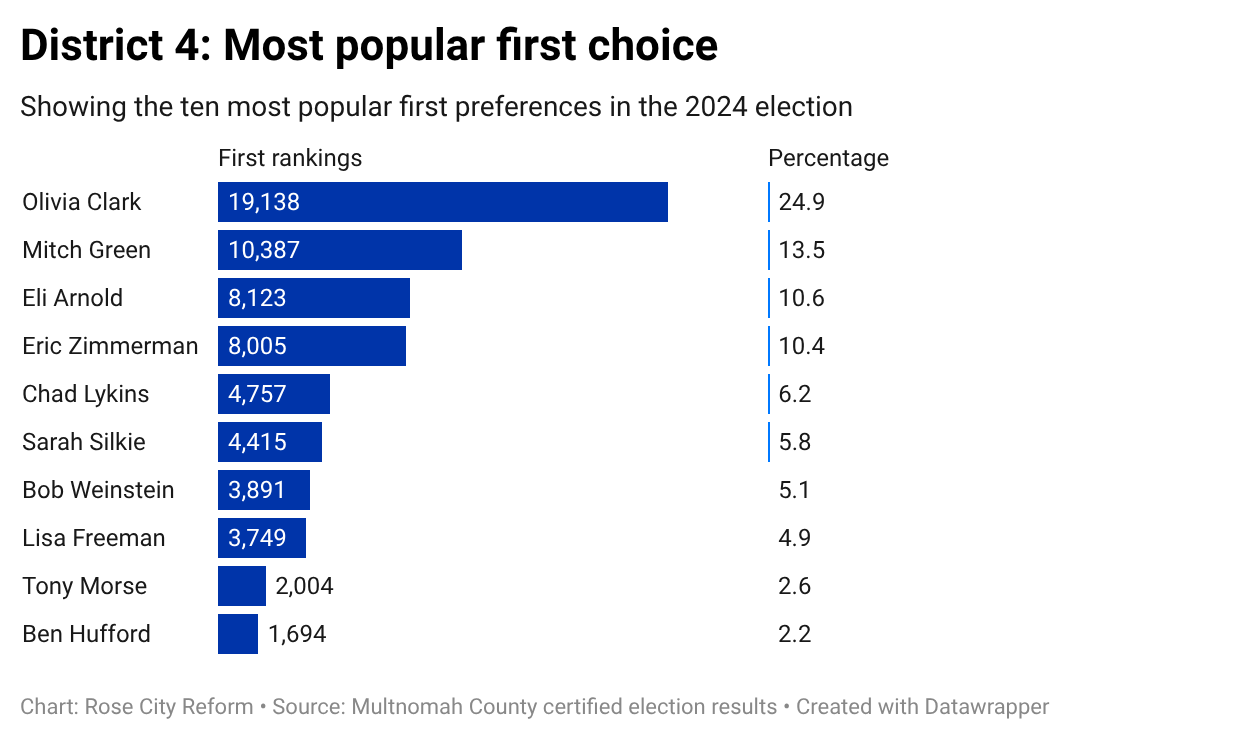
Olivia Clark, a long-time legislative operator, led from the first round with 19,138 first-choice votes, just 42 votes shy of the 19,180 quota needed to win.1 She secured her seat by round 7. Clark was in a league of her own: about 60% of the 76,717 people who cast a vote in the District 4 council race ranked her somewhere on their ballot. That made her not just the first-choice leader but also the most widely ranked candidate.2
Green, an army vet turned economist, took a slower but steady path. He started with 10,387 first-choice votes, then successively absorbed votes from eliminated candidates. A democratic socialist, he was a popular next choice for voters on the left. Green’s hold on the second seat was stable: he led Zimmerman by about 2,400 votes from the first round, and by roughly 6,500 by the time he reached the quota in round 29.
The battle for the third seat
The real drama came down to the third seat. Eric Zimmerman, a former mayoral and county staffer who also served as a platoon leader in Iraq, started out with 8,005 first-choice votes, trailing Eli Arnold, a police officer and crisis intervention specialist, by 118 votes. Notably, like Green and Zimmerman, Arnold has a military background: he is a trained Blackhawk pilot.
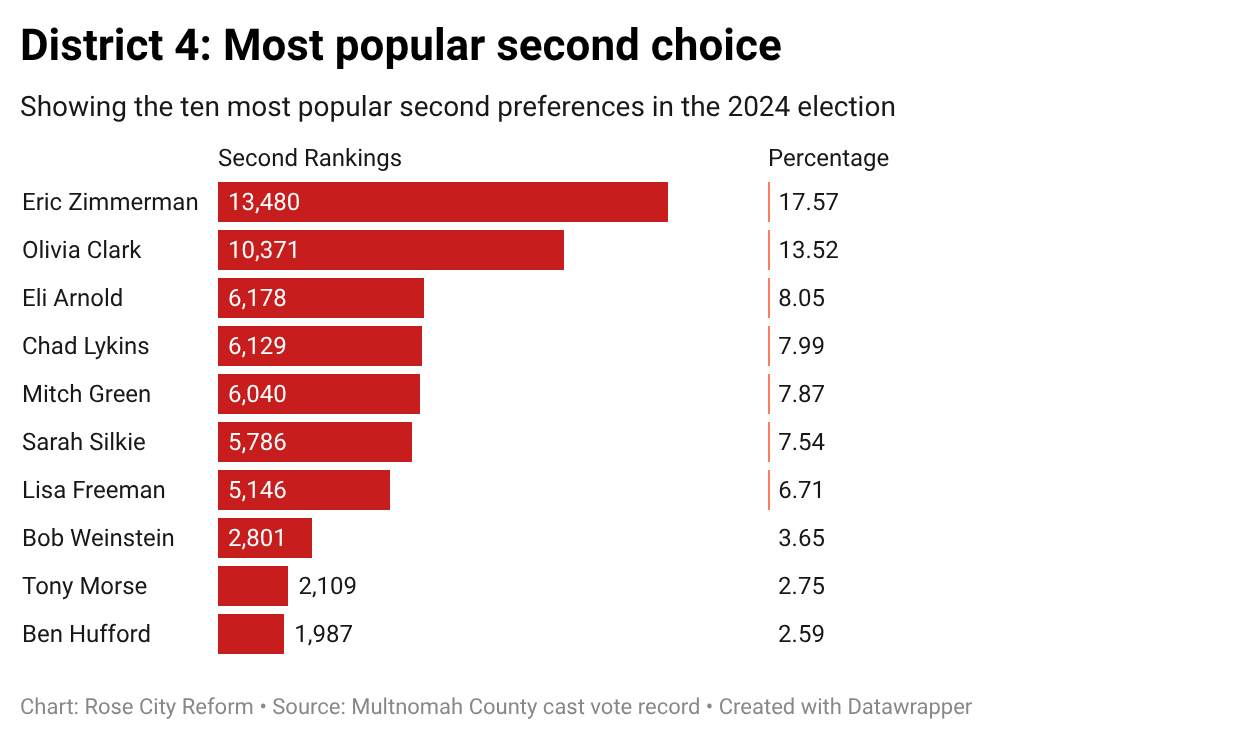
Zimmerman and Arnold traded places more than once before the race was over. Ultimately, Zimmerman had the edge because he was a more popular second choice. About 18% of District 4 voters gave him their second ranking, making him the most popular backup choice in the race. Arnold’s voters were no exception, and when Arnold was eliminated, a whopping 6,459 of his votes counted for Zimmerman. Those transfers came from both second and lower rankings, because by that point Zimmerman was the only candidate left in the race who could receive votes.3
How close was it really?
The final vote count tells us little about how close it was between Arnold and Zimmerman. That’s because Zimmerman’s final total includes the sizable transfer he picked up when Arnold was eliminated. A better measure is the gap between the two at the point when Arnold was eliminated: 874 votes.
It was close, but it wasn’t the closest race in 2024. In District 1, the gap between now-Council President Jamie Dunphy and runner-up Terrence Hayes was 809 votes, an even tighter margin than between Arnold and Zimmerman.
Two distinct voter blocs
Here, it's worth zooming out to consider the broader dynamics of the 2024 election. District 4's voters largely split into two blocs. The larger bloc favored Clark, Zimmerman, and Arnold, whose politics the media often describes as moderate or centrist. The smaller bloc leaned toward Green, who ran as a democratic socialist, along with Silkie, Lykins, and Freeman, who ran as progressives. While some readers take issue with these labels (for good reason, since the moderate label is rarely used by candidates or councilors themselves), voting patterns show that voters sorted along those political lines fairly consistently, and more vote transfers happened within the respective groups than between them.4
This goes a long way toward explaining the outcome of the election. Under Portland’s new voting method, a cohesive voting bloc needs to capture just over 25% of the votes to elect its preferred candidate.5 The smaller voting bloc had enough support to elect Green. The larger bloc had enough to elect two candidates: Clark and Zimmerman.
Yet there was crossover between these voting blocs, and that crossover proved important. Given Zimmerman's now-cemented reputation as a moderate, it may surprise you which voters pushed him past Arnold. In the final rounds, it wasn't transfers from fellow moderates that gave Zimmerman his lead, because he and Arnold largely split those votes. Rather, it was transfers from the progressive camp that made the difference. As Lisa Freeman, Chad Lykins, and Sarah Silkie were knocked out, much of their support went to Green. But enough crossed to Zimmerman (about 2,600 to Arnold's 1,600) to give him the third seat.
Same, but different
Even though the District 4 election in 2026 will feature the same four key players as in 2024, the conditions could be quite different.
Let’s start with what we know: Clark, Green, and Zimmerman are now incumbents. That means they get the usual incumbent advantages (name recognition, a larger platform, and an established donor base), as well as the potential baggage (unpopular votes, unfavorable approval ratings, and so on) that incumbency entails.
The field could also be a lot smaller. As of today, eight candidates have qualified for the ballot in District 4, compared to 30 names in 2024.6 Challengers include Jamey Evenstar, a former staffer to City Commissioner Chloe Eudaly and City Councilor Candace Avalos, and Jeremy Beausoleil Smith, a capital projects manager at Portland State University. Both are running as progressives.
Even if the number grows between now and the late-August filing deadline, what matters most is how many of them can attract meaningful vote shares. In 2024, an unusual number did: seven eliminated candidates each accumulated more than 2,000 votes, all of it up for transfer.
Why ballot size matters
A smaller field means votes aren’t split across as many candidates, so initial vote shares get larger. It also produces fewer rounds, and fewer rounds mean fewer variables that can change the outcome.
If at least one candidate wins a seat outright in the first round, it has consequences for other candidates. First, elected candidates can’t continue to receive votes, which means more potential transfers for everyone else. Secondly, if a winning candidate exceeds the quota with a surplus of votes, that surplus boosts the second choices of voters who ranked the winner first. In 2024, by the time Clark reached the quota, her surplus was only 2 votes. Green’s surplus was nearly 1,000 votes, but because he reached the quota after many rounds, most of his voters’ next rankings were no longer in the running. Zimmerman’s surplus was the largest at 1,052, but reached no one, since all remaining candidates had been eliminated.
Imagine instead that a popular incumbent clears the quota by thousands in the first round. Those extra votes then flow into the contest for the other two seats. In a close race, that could make a real difference.
With fewer rounds, first-round order also becomes increasingly important. Since eliminations happen from the bottom, a candidate’s objective in each round is to avoid being last. In a quicker race, there are fewer opportunities to come from behind and overtake a leading candidate.
A midterm year
One final consideration is that unlike 2024, this is a midterm election.7 Historically, turnout in Multnomah County runs about 10 to 12 points lower in midterm years than in presidential ones.8 This means a slightly different electorate, and in a race decided on small margins, which voters turn out for which candidates could make a difference.
For readers who are waiting for a prediction at the end of this post, sorry to disappoint. The outcome is anyone's guess. But I hope this post, however data-heavy, might make the mechanics of proportional ranked choice voting somewhat less mysterious. In 2024, District 4 had enough voter support to elect one democratic socialist and two candidates from the so-called moderate camp. Will voters break the same way in 2026, and if so, who will it be? That's a question only District 4 voters can answer.
Malen Cuturic contributed research to this post.
The quota, also called threshold, is 25% + one vote. When you reach it, you are elected.
Source: Multnomah County’s cast vote record, an anonymous record of voters’ rankings
When a candidate is knocked out, each of their ballots goes to its highest-ranked candidate still in the race. At the time of Arnold’s elimination, Clark and Green were already elected and the only active candidate was Zimmerman.
Ranking patterns show two distinct voting blocs. The larger bloc: Clark, Zimmerman, Arnold, Weinstein, Morse, Hufford, Goldsmith, Penkin, and Toran. The smaller bloc: Green, Lykins, Silkie, Freeman, and Vltavín. When one of these candidates was eliminated, their votes transferred to another in the same bloc more often than to the other: about 49% versus 17% for the larger bloc, and 52% versus 19% for the smaller. The rest exhausted or went to other candidates.
“Preferred candidate” here means the top vote-getter within that bloc.
The filing window closes on August 25, 2026.
Districts 1 and 2 vote in presidential years, Districts 3 and 4 vote in the midterms. Because all districts elected representatives in 2024, when the new district system began, District 3 and 4 reps are serving shortened terms until 2026.
Source: Multnomah County’s 2024 Ballot Data Report and historical turnout statistics.
Amazing analysis here! Much appreciated!
Yes, I agree "moderate" may be an imprecise term for Zimmerman's camp of consolers since they don't directly use it. Perhaps a better moniker would be Portland Metro Chamber/Portland Business Alliance-backed candidates since that is where the political directives and frequent divides with the other 6 councilors seem to arise. It's a rhetorical disservice to act like "but these councilors' politics are just way too complicated" as opposed to the councilors formerly known as Peacock. They are a consistent voting block on almost all issues of conflict, and they shouldn't just get to pretend to be apolitical actors that just care about district constituents issues.